365 Meds Online 24-7 – Finding your way to a better lifestyle

For decades, the cultural narrative surrounding aging and physical fitness has been fundamentally flawed. We are conditioned to view growing older as an unavoidable, steep decline into fragility, where the only appropriate physical activities are light walking and perhaps gentle stretching. This perspective is not only outdated but biologically inaccurate. While it is true that the human body undergoes physiological changes as the years pass, the rate and severity of that decline are largely within our control. The loss of physical capability is rarely the result of simply adding years to your life; more often, it is the direct consequence of under-using your physical machinery.
Maintaining physical fitness as you age is no longer about chasing the aesthetic ideals of your twenties. It transforms into a far more profound pursuit: the preservation of your independence, your resilience, and your physical agency. To stay strong with age, you must abandon arbitrary workout routines and adopt a strategic, deliberate approach to exercise that targets the specific biological systems most vulnerable to the passage of time.
The Biological Imperative of Resistance Training
The cornerstone of any longevity-focused fitness strategy is heavy, deliberate resistance training. Starting in our thirties, the human body naturally begins to lose muscle mass at a rate of roughly three to eight percent per decade, a condition known as sarcopenia. This is not merely a loss of physical strength; it is a metabolic crisis. Muscle tissue acts as a vital metabolic sink, regulating blood sugar and supporting insulin sensitivity. When you lose muscle, you lose your metabolic engine.
Furthermore, resistance training is the single most effective intervention for preserving bone density. According to Wolff’s Law, bones remodel and become stronger in direct response to the mechanical stress placed upon them. When you lift a heavy weight, the muscles pull against the tendons, which in turn pull against the bone. This micro-stress signals the skeletal system to lay down new bone tissue. Walking or swimming, while excellent for cardiovascular health, do not provide the necessary mechanical loading to halt osteopenia or osteoporosis. You must expose your skeletal system to progressive, challenging resistance.
Prioritizing Compound Over Isolated Movements
To maximize the benefits of resistance training, shift your focus away from isolated bodybuilding exercises—like bicep curls or calf raises—and prioritize compound, multi-joint movements. These exercises force the body to operate as a coordinated system, exactly as it does in everyday life.
Mastering the foundational movement patterns—the squat, the hip hinge, the push, the pull, and the loaded carry—will deliver the highest return on your physical investment. A properly executed goblet squat or a Romanian deadlift does more than build leg strength; it fortifies the lower back, engages the core, and trains the central nervous system to stabilize the spine under a load.
The Forgotten Metric: Preserving Power and Speed
When older adults design an exercise program, they almost always focus on endurance or slow-grinding strength. While both are critical, they ignore the physical quality that diminishes the fastest as we age: power. Power is the ability to generate force quickly.
Biologically, our muscles are composed of slow-twitch fibers (used for endurance) and fast-twitch fibers (used for explosive movements). Aging disproportionately targets and atrophies our fast-twitch muscle fibers. This loss of power is precisely why older adults become highly susceptible to catastrophic falls. When you trip on an uneven sidewalk, absolute strength will not save you; it is your capacity to quickly and explosively step forward to catch your balance that prevents a fractured hip.
Integrating Velocity into Your Routine
You do not need to perform advanced Olympic weightlifting or dangerous box jumps to train for power. You can integrate velocity training into your routine safely and effectively by simply changing the intent of your movements.
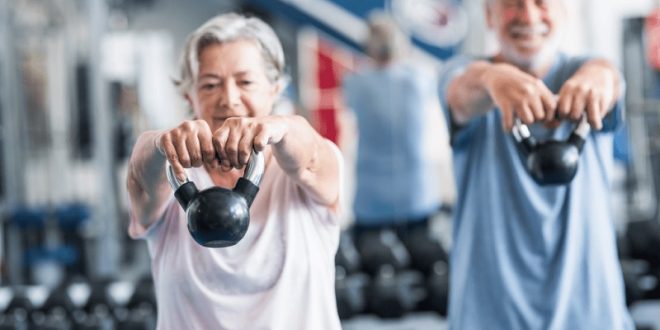
Select a relatively light weight—roughly forty to fifty percent of your maximum capability. When performing a movement like a kettlebell swing, a medicine ball throw, or even a basic push-up on an elevated surface, lower the weight with slow control, but explode through the upward phase as fast as humanly possible. This intention to move rapidly forces the central nervous system to recruit those dormant fast-twitch muscle fibers, preserving your fast-acting reflexes and overall physical durability.
Building Resilience Through Unilateral Training
Most standard exercises, such as a barbell bench press or a bilateral leg press, allow the body’s dominant side to mask the weaknesses of the non-dominant side. Over decades of movement, these subtle imbalances compound, eventually leading to joint pain, altered gait mechanics, and a heightened risk of injury.
Unilateral training involves exercising one side of the body at a time. Movements like the Bulgarian split squat, the single-leg Romanian deadlift, and the single-arm overhead press are indispensable tools for the aging athlete. When you stand on one leg to perform a lunge, you are not just strengthening the quadriceps and glutes; you are aggressively demanding that the stabilizing muscles of the hips, knees, and ankles engage to prevent you from falling over. This builds immense joint stability and directly improves your functional balance, ensuring you remain sturdy and confident on your feet regardless of the terrain.
Active Mobility and Connective Tissue Health
Flexibility and mobility are frequently confused, but they are entirely different concepts. Flexibility is the passive ability of a muscle to stretch, whereas mobility is your ability to actively control a joint through its entire range of motion. As we age, joint capsules stiffen, and connective tissues—tendons and ligaments—lose their elasticity. A muscle might be strong, but if the joint it acts upon cannot move freely, that strength is useless.
To maintain joint health, mobility work must become a daily non-negotiable practice. This involves taking your major joints—specifically the shoulders, hips, and ankles—through their absolute end ranges of motion with control and tension.
Furthermore, you can fortify your tendons through eccentric loading. Tendons respond exceptionally well to time under tension. By deliberately slowing down the lowering phase of any exercise—taking four to five seconds to descend into a squat or lower a dumbbell during a row—you stimulate the connective tissues to become thicker and more resilient, drastically reducing the likelihood of tears and chronic tendinitis.
Overcoming Anabolic Resistance with Strategic Nutrition
Exercise provides the stimulus for physical preservation, but nutrition provides the building blocks. A significant challenge in aging physiology is a phenomenon known as anabolic resistance. Essentially, an older body is less efficient at utilizing dietary protein to build and repair muscle tissue than a younger body.
To overcome anabolic resistance, the minimum daily requirement for protein must increase, and the distribution of that protein matters immensely. Consuming a massive steak at dinner while eating minimal protein for breakfast and lunch is an inefficient strategy for muscle preservation. To maximally stimulate muscle protein synthesis, you must consume a substantial bolus of high-quality protein—typically between thirty to forty grams—evenly distributed across three to four meals a day. When combined with progressive resistance training, this nutritional strategy overrides the body’s natural tendency to break down muscle tissue.
Aging does not have to be defined by physical regression. By treating exercise as a precise, targeted intervention—prioritizing heavy lifting, explosive power, unilateral stability, and intelligent joint care—you can fundamentally rewrite your biological trajectory. You hold the capacity to build a body that not only withstands the demands of time but continues to move through the world with strength, capability, and unwavering confidence.